

On Wednesday, August 5, 2026, the USD/CHF witnessed significant volatility as the dollar fell to an intraday low of 0.80742 against the Swiss franc in early trading hours before rebounding to the 0.80861 level. This choppy intraday volatility can be associated with a tug-of-war between easing geopolitical conditions and the nation’s monetary policy.
Swiss Franc Retreats as Geopolitical Premium Fades
The early morning rally in Swiss francs against the US dollar was triggered amid the diplomatic breakthrough in the Middle East. According to a report from AXIOS, the U.S., Iran, and Oman are closing in on an interim deal to reopen the Strait of Hormuz, with the U.S. aiming for a Wednesday announcement.
Under the proposal, Iran and Oman will set a 60-day temporary arrangement to allow safe passage through the waterways.
The progress quickly reduced the geopolitical risk premium that had supported the dollar for months. As systemic concerns eased, crude oil prices continued to decline globally. However, some institutions could reduce their purchases of the dollar as a safe haven and protectionist currency, a move that helped the Swiss franc and hurt the U.S. dollar.
The development comes as a sign of progress in an important energy choke point, with markets responding quickly to the potential for more stable shipping.
The Swiss Economic Reality Cushions the Slide
However, the Swiss franc’s rally proved short-lived as market participants shifted focus back to underlying economic data. A recently released macro report indicates that Switzerland is currently experiencing a very different inflation environment than the rest of the developed world.
In a recent currency research briefing, Elias Haddad, Senior Markets Strategist at Brown Brothers Harriman (BBH), observed that “Swiss July CPI stays muted.” The headline consumer price index printed at 0.4% year-over-year, dropping from 0.5% in June, while core CPI remained completely flat at 0.3% year-over-year for a fourth straight month.
The “bottom line,” according to Haddad, is that “the SNB has plenty of room to keep rates at 0.00% for some time, which is an ongoing drag for CHF.” This prolonged low-rate environment explains why “CHF is the worst performing G10 currency so far this quarter,” as yield-seeking investors continuously use the Swiss franc as a cheap funding currency.
Central Banks Express a Pragmatic Way Forward
The afternoon rally towards 0.80968 was also supported by a sharp reminder of the SNB policy stance. SNB Chairman Martin Schlegel recently reiterated that the SNB is in an “aggressive readiness” to actively intervene in foreign exchange markets. The SNB is still very much focused on a too-strong franc, as it risks harming small and medium-sized Swiss exporters, which are now pressing for a state-backed insurance policy against the franc’s appreciation
At the same time, the Fed’s interest-rate outlook continues to be largely data-dependent. While cooling global indices keep upcoming rate decisions volatile, the resilient underlying US economic engine prevents a wholesale abandonment of the greenback.
USD/CHF Pair Rides a Steady Uptrend within Channel Pattern
From the July 29th high of 0.820, the USD/CHF pair dropped to the current exchange value of 0.8095. While the recent strength in the Swiss franc came from easing geopolitical tensions, the technical chart projects its own theory with a channel pattern formation.
Since late January 2026, the pair has been resonating within two ascending trendlines that act as dynamic support and resistance for market participants. Historical trend shows a rebound from either trendline drives a price move to the opposite end of the channel.
Thus, the USD/CHF pair could continue its downward momentum and drop another 1.79% to hit the 0.794 floor and retest the channel support.
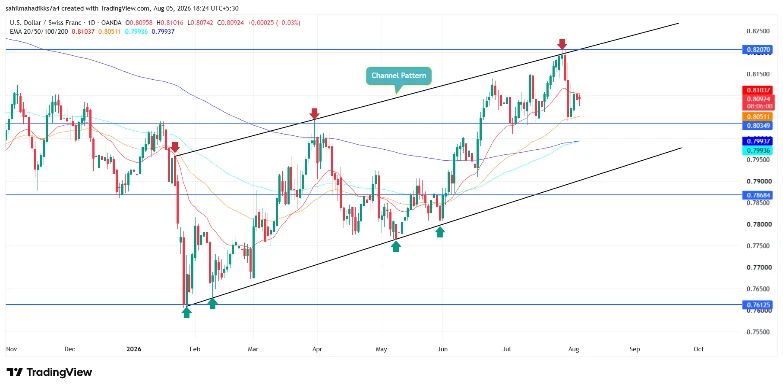
The 0.8035 and 200-day exponential moving average at 0.800 stands as key immediate support for the pair, while the 0.820 level is the crucial horizontal resistance.