

On Wednesday, August 19th, the South Korean Won (KRW) witnessed a sudden spike against the US dollar, breaking a key psychological level of 1,400. By press time, the USD/KRW was down roughly 1.52%, hitting an intraday low of 1,388.18—its lowest level since September 2025.
While the South Korean Won has been projecting significant strength against the greenback since early July 2026 amid large-scale, automated dollar-selling programs executed by Seoul-based custodian banks on behalf of foreign institutional investors.
These automated sales coincided with a rapid increase in South Korea’s export economy amid demand for artificial intelligence infrastructure and High-Bandwidth Memory (HBM) chips amid a wave of corporate cash repatriation.
The Custodian Bank Pipeline & Corporate Repatriation
Wednesday’s dramatic move was driven by heavy dollar liquidation by major local custodian banks. These banks have been selling massive blocks of U.S. dollars on a systematic basis to pay for foreign buying of local tech stocks, institutional desks said.
Much of this automatic sale is directly linked to the structural cash pipelines of South Korea’s biggest semiconductor firms. Recently, tech major SK Hynix launched a massive American Depository Receipt (ADR) fundraising marathon in New York, raising billions of dollars from foreign investments. The company has been systematically repatriating these USD proceeds to local currency in order to invest in its domestic manufacturing infrastructure, comprising a newly fast-tracked USD 54 trillion investment in its Yongin and Cheongju production bases.
Moreover, the local supply of dollars has been significantly increased by the expansion in exporters’ dollar sales in advance of corporate tax prepayments, creating a localized dollar glut that drove the USD/KRW rate down very quickly.
Concurrently, SK Hynix’s recent announcement of a historic 40 trillion won ($29 billion) share buyback further supercharged institutional demand for the currency.
Fundamental Strength: The AI Chip Trade Wind
In addition to local banking flows, the won’s strength stems from a stellar macro re-rating for South Korea’s export economy. Soaring global demand for AI infrastructure and High-Bandwidth Memory (HBM) chips has propelled South Korea’s current account surplus to record highs. As local think tanks repeatedly raise their annual surplus forecasts, this surging trade strength provides solid macroeconomic backing for investors bullish on the South Korean Won.
According to a recent report from Korea JoongAng Daily, the state-run Korea Development Institute (KDI) raised its 2026 growth forecast to 3.2% from 2.5% on Wednesday.
The 0.7% jump is predominantly fueled by the semiconductor industry as the world grapples with a massive demand for AI infrastructure.
“More than half of this year’s 3.2 percent growth can be seen as semiconductor-related,” said Kim Mee-roo, senior director of KDI’s Department of Macroeconomic and Financial Policies.
KPI also expects an 8.7% export growth this year, which is 4.1% above its May forecast, while equipment investment is projected to rise 7.9%, up 4.6% from the previous estimate.
Fading US Dollar Yield Advantage
Hawkish Fed expectations fell sharply after recent US economic data disappointed, driven by cooling CPI and PPI readings and a surprisingly steep decline in retail spending. Traders have begun to cut their expectations of a prolonged Fed hawkish stance, and 10-year USTs fell from their multi-month highs. This reduced the spread in yields between the dollar and emerging-market currencies, leading to a general shift of institutional capital from the US dollar to highly competitive Asian export currencies such as the won.
USD/KRW Pair Prepares Next Breakdown Amid EMA Crossover
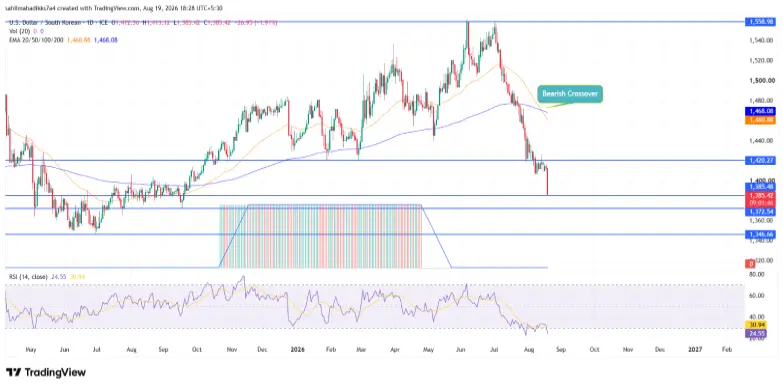
Since early July, the USD/KRW pair has showcased a steady downtrend, pulling its exchange rate from 1,557 to 1,3888, registering a 10% decline. The increasing strength of the South Korean won has pulled this pair below key exponential moving averages of 20, 50, 100, and 200.
If current momentum persists, the USD/KRW pair would likely challenge the next chart support of 1,385. A recent bearish crossover between the 50- and 200-day moving averages should raise speculative selling pressure in the forex market and bolster the next breakdown.
If the pair flips this immediate support into resistance, the KRW could drop to 1,372 or 1,366 in the near term.
On the other hand, this volatility of the exchange rate may create instability because it directly affects the trade relations between the two countries.