

Japan and the United States will “certainly” conduct more coordinated market interventions if the Japanese yen starts to decline again. The warning follows the heels of a large-scale, historic buy of the yen, which was able to pull the currency back from its multi-decade lows.
Pledging Conditional Return to the Market
According to former BOJ official Atsushi Takeuchi, the joint action successfully shattered expectations of a one-way market. “The fact the US stood behind Japan and took action has a huge symbolical meaning,” Takeuchi stated. “What has become clear is that there are effectively no constraints preventing Japanese authorities from intervening.
“This defensive alliance serves as a severe warning to aggressive currency speculators. “If I were running a hedge fund, I won’t think about making bets on USD/JPY now,” Takeuchi remarked. Analysts note that this symbolic threat carries massive weight, forcing traders to reconsider short positions to avoid fighting two global economic superpowers.
This is the same tone as that from the active administration itself. After the surprise coordinated action, Japanese Finance Minister Satsuki Katayama told reporters that Japan will not hesitate to engage in further coordinated action, an aggressive move that was immediately supported by the U.S. Treasury Secretary Scott Bessent.
Why the US Changed its Currency Strategy
Such coordinated foreign exchange operations are very rare and are a significant departure from the traditional U.S. financial policy, which emphasizes the free market valuation of currencies. Ultimately, Washington joined Japan in trying to prevent serious spillover risks into its own domestic bond markets.
Bond Contagion Fears
The Japanese yen briefly hit a 40-year low against the dollar in July 2026, as it continued to weaken amid intense selling pressure. This coincided with a sharp sell-off in Japanese Government Bonds, sending yields to multi-decade highs. Japan is still the top foreign holder of U.S. Treasuries. Washington officials worried a further yen weakness would force Tokyo to sell off substantial amounts of its Treasury stock to get dollars to prop up the currency. Those sales could raise yields and loan rates in the U.S., including mortgage rates, incurring a wider financial hardship for many Americans.
The Federal Reserve Liquidity Backstop
The United States provided an alternative liquidity channel to help limit this systemic risk. Treasury Secretary Scott Bessent confirmed readiness to expand the capacity of the Federal Reserve’s Foreign and International Monetary Authorities (FIMA) repurchase facility. It enables Japan to temporarily exchange its U.S. Treasury securities to the Fed for dollars. Tokyo is then able to buy yen with no bonds being sold into the open market, thus removing direct pressure on U.S. bond prices.
Market Implications and the Path Ahead
The coordinated action worked, as the yen was brought from the danger zone near 164 to a better level at mid-to-low 155s. Macro analysts pointed out that U.S. involvement heightened the deterrence stakes and sent a message to big hedge funds and speculators that shorting the yen was a much riskier bet.
However, market watchers point out that the physical barriers are merely “short-term protection. The persistent yield differential between the higher-yielding Federal Reserve and the still relatively low rates at the Bank of Japan continues to weigh on the currency. The yen will stay structurally weak as long as Japan’s leaders delay a clampdown on expansionary fiscal policies and allow the BOJ to begin to increase rates more gradually. On both sides, officials have already said they are ready to re-enter the market if there is any disorderly move in the yen.
Technical Analysis: USD/JPY Breaks Major Uptrend Support
From the July 29th high of 163.908, the USD/JPY pair dropped to the current exchange value of 157.72, registering a drop of 3.72%. This pullback shows a decisive breakdown below the support trendline of a long-coming channel pattern in the daily time frame chart.
Since April 2025, the ascending trendline of this pattern acted as a dynamic support and constantly pushed YEN to higher exchange rates. Following this breakdown, the pair could potentially jump to 158.8 per dollar and retest the breached trendline as potential resistance.
If the resistance holds, the YEN could gain additional strength and drop below 155 against the greenback.
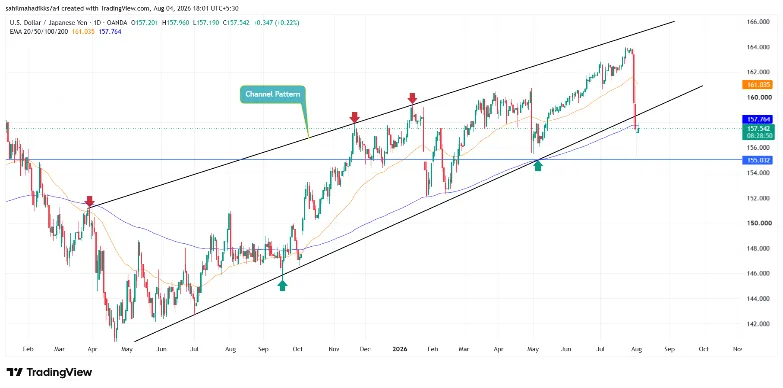
The USD/YEN below the daily exponential moving averages (20, 50, 100, and 200) highlights a positive shift among traders.