

The Indian Rupee (INR) registered a sharp gain of 27 paise against the U.S. dollar during Monday’s Asian market, marking an intraday low of 95.11, according to interbank foreign exchange data. This jump of roughly 0.30% from last Friday’s closing of 95.38 can be linked to domestic economic support and sudden shifts in global macroeconomics.
Rupee Jumps Amid Easing U.S.-Iran Conflict
INR’s recent strength against the greenback followed immediate relief in global markets after U.S. President Donald Trump halted planned military strikes against Iran. According to a Truth Social statement on Sunday, August 2nd, Trump noted that while the U.S. was “locked and loaded and ready to go… at levels of Military Terror, Strength, and Power not seen since World War II,” a diplomatic pivot occurred.
He stated, “We have just been asked by Iran, and other Middle Eastern countries, to hold off any attack in that the perimeters of a deal have been agreed to. “The agreement hinges on the “Immediate, Complete, and Total OPENING OF THE HORMUZ STRAIT,” a vital global oil shipping artery. This quick de-escalation defused the geopolitical risk premium from crude markets and dampened demand for the dollar as a safe-haven currency, helping the rupee’s rapid appreciation.
The Steep Retreat of Crude Oil Prices
On Monday, August 3, 2026, global energy markets saw a dramatic reversal, with international oil indexes tumbling as a result of U.S.-Iran diplomatic progress. Brent crude futures for the October 2026 futures contract fell 5% to $84 a barrel, reversing a significant portion of its +20% surge during the late July rally.
India relies heavily on imports to fulfill its domestic petroleum requirements, and therefore, the high energy prices directly balloon the country’s Current Account Deficit (CAD). This abrupt decline in energy prices directly eases the high imported inflationary pressures on India’s economy.
Anticipation Ahead of RBI Monetary Policy
The major local driver for Indian currency this week is the Reserve Bank of India (RBI) monetary policy decision on Wednesday. Economists at ING Research expect the central bank to stay the course, saying, “We expect the RBI to keep the repo rate unchanged at 5.25% on Wednesday.
ING analysts note that while “headline inflation surprised to the upside in June, largely due to higher fuel prices,” the broader macro picture remains stable. They emphasize that “underlying price pressures remain contained” and “core inflation continues to run below the RBI’s target,” giving policymakers room to pause while monitoring global inflation risks.
Inflow of Capital and Surging Forex Reserves
Robust domestic data and inflows of foreign capital are providing strong structural support to the Indian rupee. According to official NSE exchange data, Foreign Institutional Investors (FIIs) purchased equities worth ₹277.48 crore on a net basis on Friday. The general positive risk-on mood in the domestic equity market provides a steady supply of dollar inflows into the banking system.
The latest RBI data released on Friday shows the country’s forex reserves jumped by $6.118 billion to reach $682.354 billion for the week ended July 24.
On Monday, the equity benchmark, Nifty 50, jumped roughly 0.87% to reach 24,664.90 rupees, and the Sensex jumped 0.7% to hit 78,639.03.
Technical Analysis- USD/INR Hints at Further Decline Amid Reversal Pattern
From the July 24 high of 96.67, the USD/INR pair has dropped roughly 1.39%— 1.34 Rupee— to reach the current trading value of 95.33. A broader analysis of the daily chart highlights a second price rejection from the 96.6-registering zone within three months, signalling a formation of a double-top pattern.
This classic bearish reversal pattern displays an ‘M’ shape structure to define intense overhead supply. If the bearish momentum persists, the Indian Rupee could breach the 95.22 support level against USD and drive an extended correction to 94.15.
This support stands as a pivot platform for the INR/USD pair as a long-coming support trend coincides at the same region.
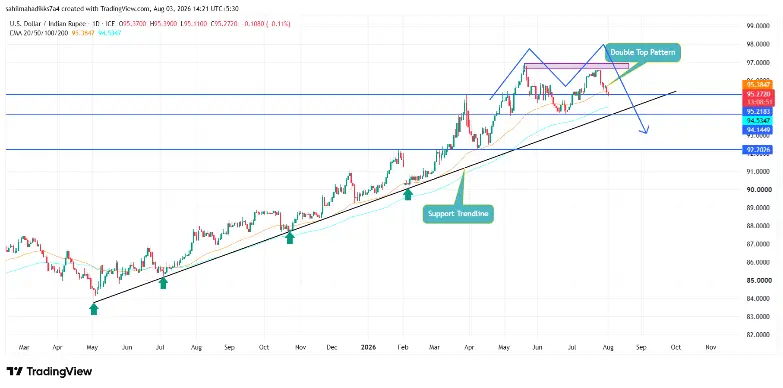
Since May 2025, this ascending trendline has acted as dynamic support that prevents the Indian currency from entering a deeper discount against the greenback.