Friday, September 4, 2026
Home Blog Page 5

Bitcoin Demand Remains Resilient Amid Price Volatility; $125K BTC Soon?

Bitcoin Price Analysis
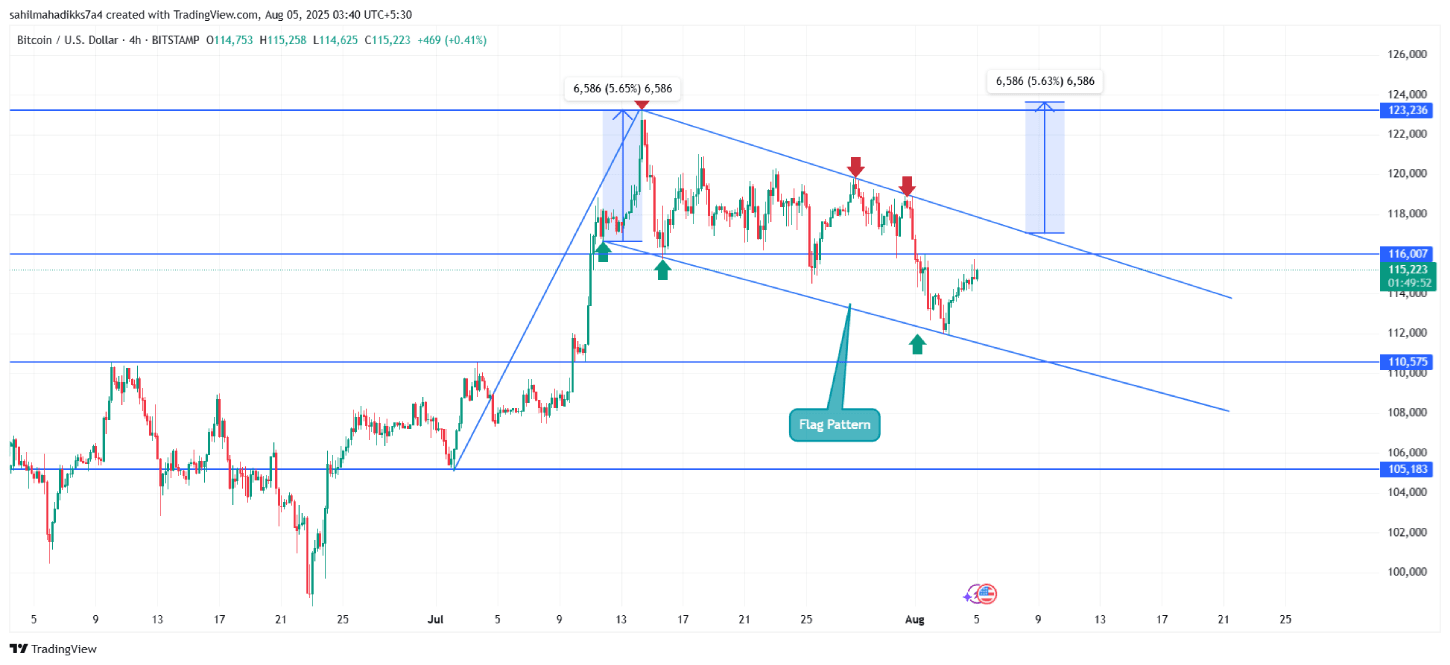
  • The Bitcoin price is nearing a bullish breakout from a bullish continuation pattern called a ‘flag.’
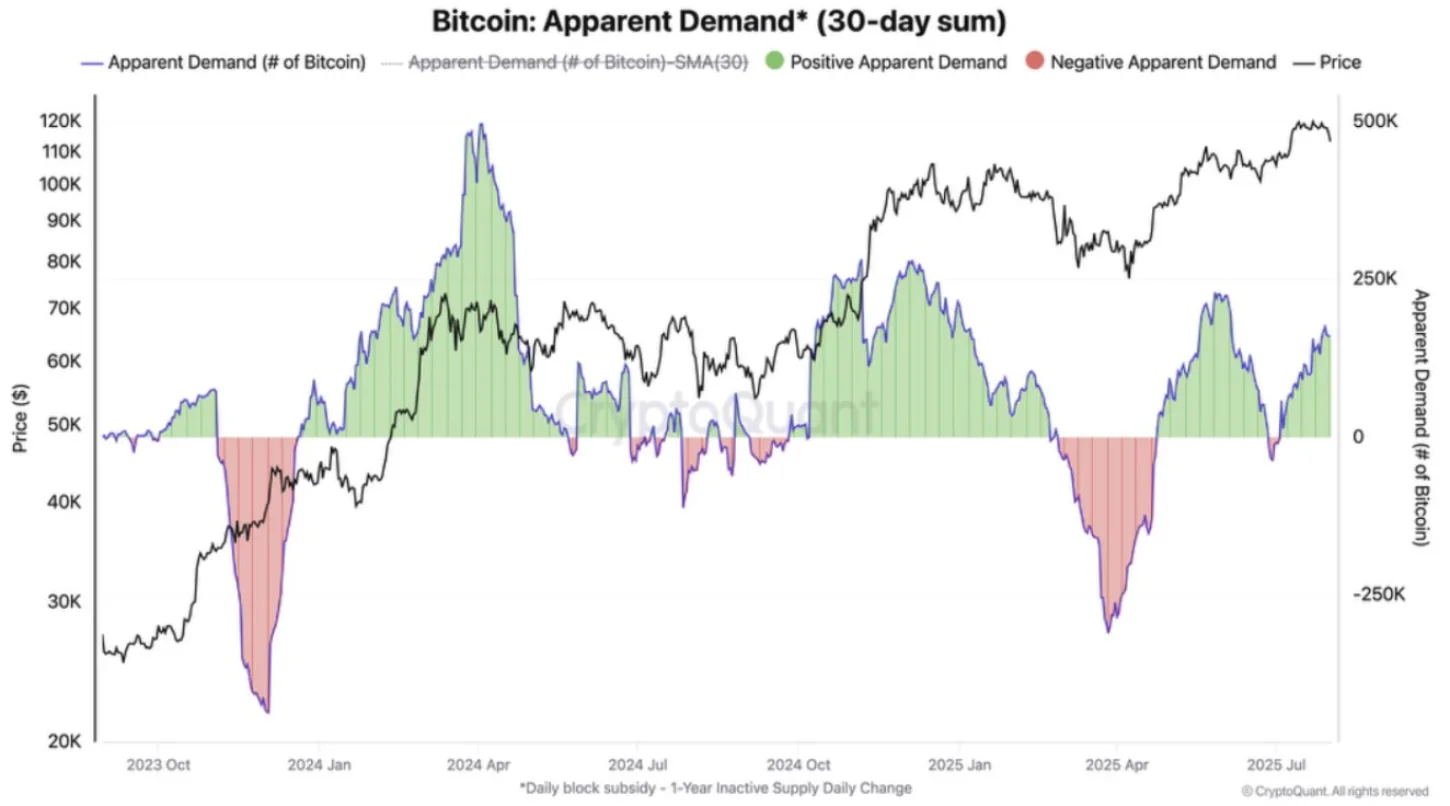
  • BTC’s apparent demand shows a positive flag with over 160,000 accumulated since last month.
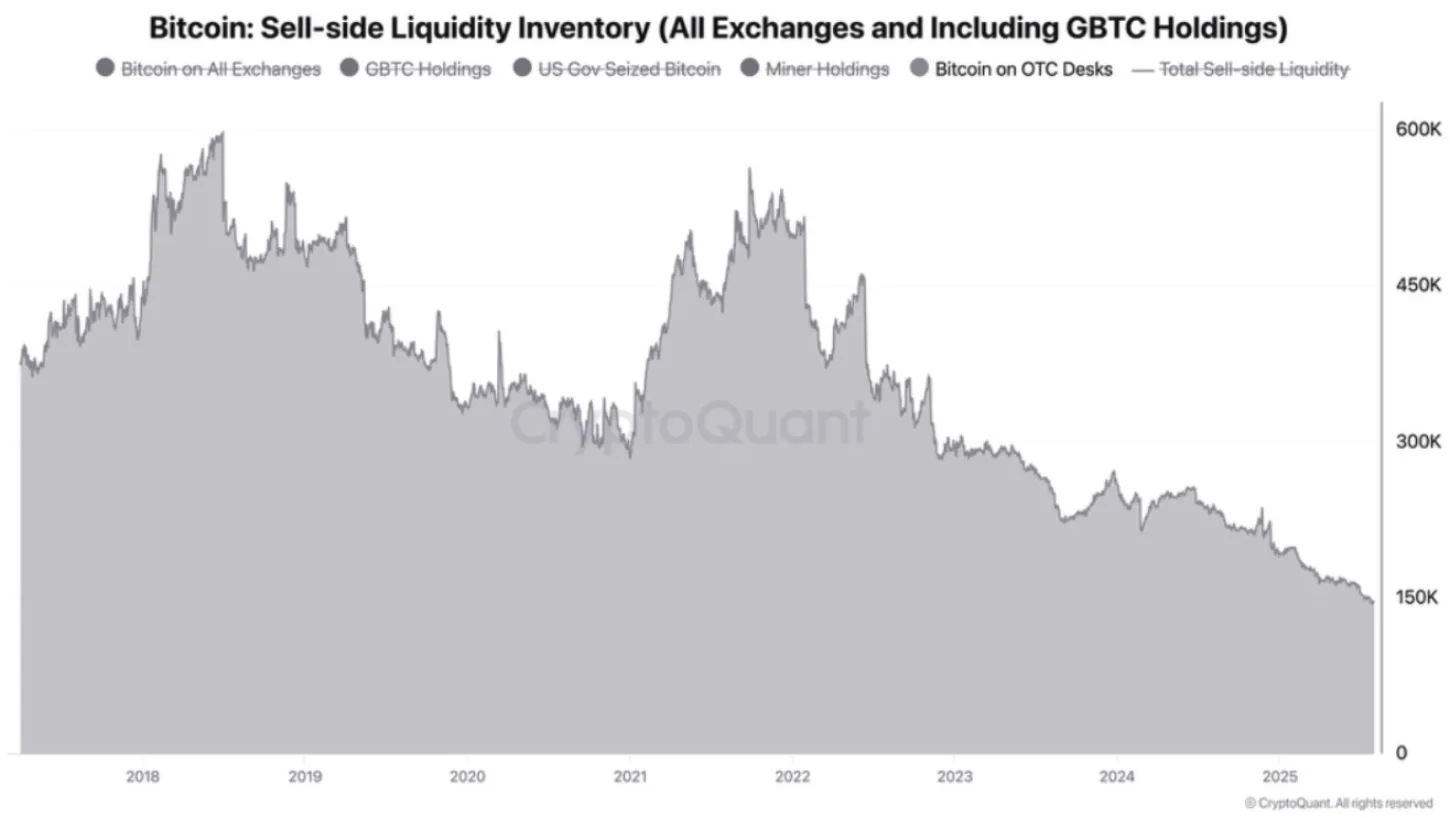
  • OTC BTC reserves have dropped from 550,000 BTC in September 2021 to 140,000 BTC now.
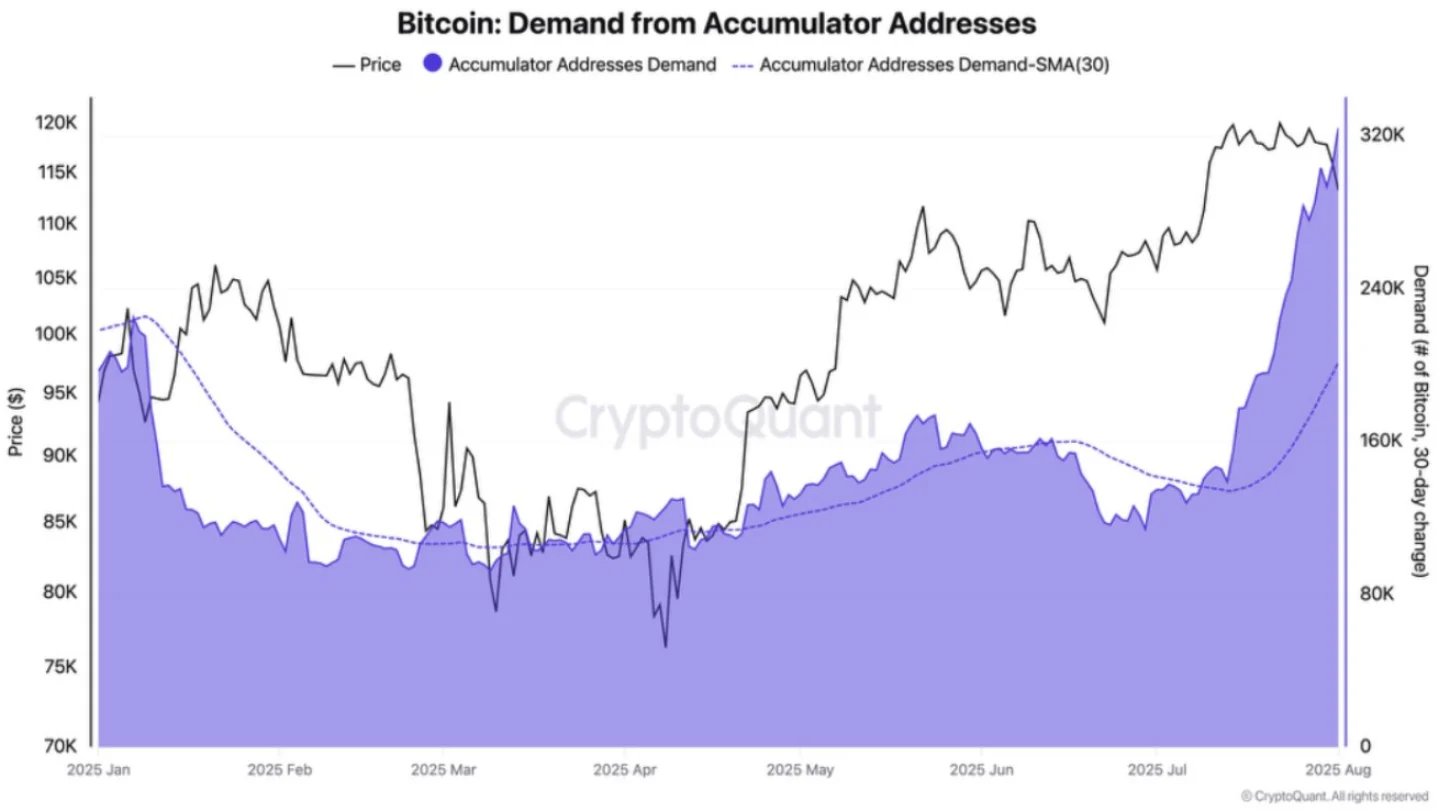
  • Accumulator addresses have increased their holding by 50,000 BTC over the past 30 days.

The pioneer cryptocurrency Bitcoin shows a slight uptick of 0.68% during Monday’s U.S. market hours. The buying pressure came as a relief rally in the broader market after a significant sell-off last week. If the pullback recovers the selling pressure in BTC, the coin price could resume its correction trend and head for the $110,000 breakdown. Despite the market fear of a prolonged downturn, the on-chain data highlights intact demand pressure for Bitcoin from new investor accumulators and institutions. Is it a rally to a $125,000 close? 

BTC On-Chain Metrics Signal Strong Demand and Accumulation

Over the past 3 weeks, the Bitcoin price showcased a notable correction from a $123,236 high to a recent low of $114,887, accounting for a 9.18% loss. The selling pressure came as a post-rally pullback for buyers to recoup bullish momentum. However, with the formation of a fresh lower high swing in BTC’s daily chart, the crowd is starting to worry about a prolonged correction trend in price. 

Despite the recent turbulence in Bitcoin price, on-chain data shows that investors’ demand remains strong and supports a potential uptrend in the near term. According to a recent insight shared by CryptoQuant Analyst Darkfost, multiple indicators confirm a substantial appetite for BTC acquisitions in short-term and long-term trends.

One key metric compares new BTC issuance with over 1-year inactive supply. If the resulting ratio is positive, it indicates more coins are being locked up than spent, signaling a next accumulation trend. According to the recent data, the demand remains clearly positive, as around 160,000 BTCs were accumulated over the past 30 days. Thus, the browser investor base is still adding coins to their positions rather than exiting.

Bitcoin Apparent demand | CryptoQuant

Another crucial indicator is the accumulator address, which highlights the addresses that have only acquired BTC without selling any, giving us an insight into both demand and holding conviction. Over the past month, the average Bitcoin accumulated by these addresses has surged roughly 50,000 BTC, showing a steady buying behavior despite the recent price volatility.

Demand From Accumulator Addresses

Meanwhile, in the over-the-counter (OTC) market—where institutions and large buyers primarily move Bitcoin supply—holdings have recorded a sharp decline. In September 2021, this desk held over 550,000 BTC, which has currently dropped to just 140,000 BTC, a sign that supply from institutions is tightening. Fewer coins on the OTC desk means less sell-side pressure and potentially tighter supply going forward.

BTC on OTC Desks

Thus, the demand-side metric shows no major red flags for BTC despite the recent price pullback. With the accumulation trend pressure intact at retail and institutional levels, the coin price could hold key support levels and drive a bullish reversal.

BTC Price Near Flag Pattern Breakout

The four-hour chart of Bitcoin price shows the formation of a bullish continuation pattern called a ‘flag.’ The chart setup is commonly spotted in an established uptrend for buyers to recapture the bullish momentum.

Bitcoin Price
BTC/USDT – 1d Chart

Currently trading at $115,244, the BTC price is less than 2% from challenging the upper boundary of the pattern. A potential breakout will signal the continuation of the prevailing recovery and bolster the asset for a $123,236 high and chase $125,000.

Also Read: Final Pullback Before XRP Price Takes $4?

CFTC Introduces Spot Crypto Trading Under Federal Oversight

CFTC Introduces Spot Crypto Trading Under Federal Oversight

Key Highlights

  • The CFTC’s new initiative would bring spot crypto trading under federal regulation for the first time
  • Stakeholders have until August 18 to weigh in on how these markets should be structured
  • Rather than wait for Congress, the CFTC is using its existing authority to fast-track oversight

The U.S. Commodity Futures Trading Commission (CFTC) has made a huge announcement for a new initiative to rein in the Wild West of cryptocurrency trading. 

Acting Chairman Caroline D. Pham announced plans on Thursday to open federally regulated markets for spot crypto trading, which is a direct challenge to the offshore exchanges that have dominated the sector with little oversight.

The initiative, part of the agency’s newly launched “crypto sprint,” seeks to allow Bitcoin, Ethereum, and other digital assets to trade on CFTC-registered futures exchanges under the same rules governing oil, wheat, and other commodities. 

If successful, it would make the first time U.S. retail investors could trade cryptocurrencies on a federally supervised platform. This would provide protections against manipulation and fraud that are virtually nonexistent on unregulated venues like Binance or Bybit.

A Regulatory End-Run?

Pham, a longtime advocate for bringing crypto under the CFTC’s umbrella, is leveraging a little-known provision of the Commodity Exchange Act that already requires leveraged retail commodity trading to occur on approved exchanges.

“Under President Trump’s strong leadership and vision, the CFTC is full speed ahead on enabling immediate trading of digital assets at the Federal level in coordination with the SEC’s Project Crypto,” said Acting Chairman Pham. 

“There is a clear and simple solution the CFTC can implement now. The Commodity Exchange Act currently requires that retail trading of commodities with leverage, margin, or financing must be conducted on a DCM. Starting today, we invite all stakeholders to work with us on providing regulatory clarity on how to list spot crypto asset contracts on a DCM using our existing authority, as I have previously proposed since 2022. Together, we will make America the crypto capital of the world,” she added further.

The move is seen as a strategic move after years of congressional gridlock on crypto regulation. Rather than waiting for lawmakers to pass new legislation, the CFTC is using its existing authority to fast-track oversight.

CFTC Seeks Public Feedback

The agency is now soliciting public feedback on critical issues, including:

  • Whether spot crypto contracts can be structured to comply with DCM listing rules.
  • How to handle assets that might fall under both CFTC and SEC jurisdiction.
  • Potential conflicts with state-level money transmission laws.

Stakeholders, from Wall Street firms to crypto startups, have until August 18 to submit comments. The feedback will shape what could become the first federally regulated spot crypto market in the U.S.

If the CFTC succeeds, it could finally bring legitimacy to a market long plagued by scandals, from the collapse of FTX to rampant wash trading. But critics warn that forcing crypto onto traditional exchanges might hinder liquidity or push traders back into offshore gray markets.

CFTC and SEC Finally Align on Crypto Regulation

The latest announcement from CFTC comes after SEC Chairman Paul Atkins announced “Project Crypto,” which will be the SEC’s north star in aiding President Trump in his historic efforts to make America the “crypto capital of the world.”

Speaking at the America First Policy Institute, Atkins explained a plan to integrate blockchain into financial markets. This approach is completely in contrast to the enforcement-heavy approach of former Chairman Gary Gensler. 

The initiative, backed by President Trump’s GENIUS Act for stablecoin regulation, aims to clarify asset classifications, streamline custody rules, and support “super-apps” for trading and lending under one license. 

In a press release, the SEC chairman made clear that “most crypto assets are not securities.” This statement will end regulatory ambiguity. 

These developments just came after the White House’s Working Group disclosed a report advocating digital asset leadership. 

Paul Atkins said, “I have directed the Commission staff to work to develop clear guidelines that market participants can use to determine whether a crypto asset is a security or subject to an investment contract. Our goal is to help market participants to slot crypto assets into categories, such as digital collectibles, digital commodities, or stablecoins, and assess the economic realities of a transaction. This approach can allow market participants to determine, based upon clear guidelines, whether any outstanding promises or commitments of the issuer cause the crypto asset to be subject to an investment contract.”

Final Pullback Before XRP Price Takes $4?

Nevermind The Ripple Lawsuit Digivault Becomes First Accredited Custodian To Support XRP
  • The XRP price call to the 50% retracement level signals a healthy pullback for buyers to regain bullish momentum
  • The flag pattern formation in the daily chart accentuates a temporary pullback before a potential breakout.
  • The declining trend in XRP’s open interest and an anticipated dive of the funding rate into the negative region indicate a weakening bullish momentum.

On August 3rd, the XRP price witnessed a notable rebound of +5.4% to reach a $2.9 trading value. The buying came as a relief rally in the broader market, as a majority of major assets showed a sudden uptick after a sharp sell-off. While the Ripple crypto follows a similar momentum, the declining trend in derivative market data signals a risk of prolonged correction. Will this correction extend below $3, or will buyers have an opportunity to counterattack?

XRP’s Derivative Metrics Turn Bearish:

In the past two weeks, the XRP price witnessed a significant correction from $3.65 to a $2.7 low, registering a 25% loss. The selling pressure follows a post-rally correction sentiment in the market, indicating a cool-off period for buyers to regain bullish momentum.

However, the derivative market decline recorded a notable drop, along with price signalling a cautionary action from traders amid market uncertainty.

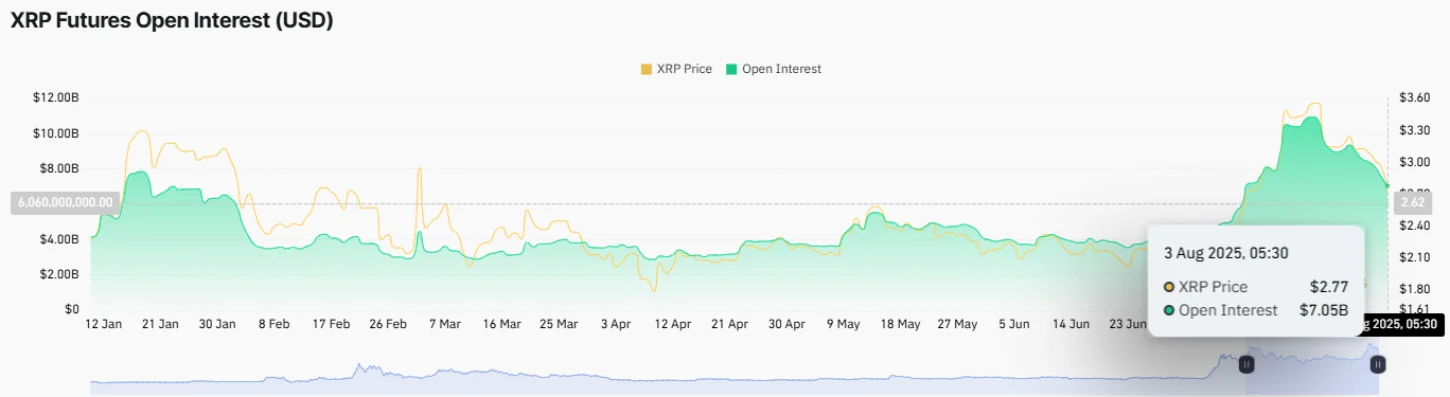
According to Coinglass data, XRP futures open interest has dropped from $10.94 billion to $7.05 billion, projecting a 35.6% drop. This significant decline in OI suggests mass liquidation or unwinding of positions in the futures market. This cooling of speculative interest could act as a precursor to a continued correction trend unless strong buying pressure returns.

XRP Futures Open Interest | CoinGlass

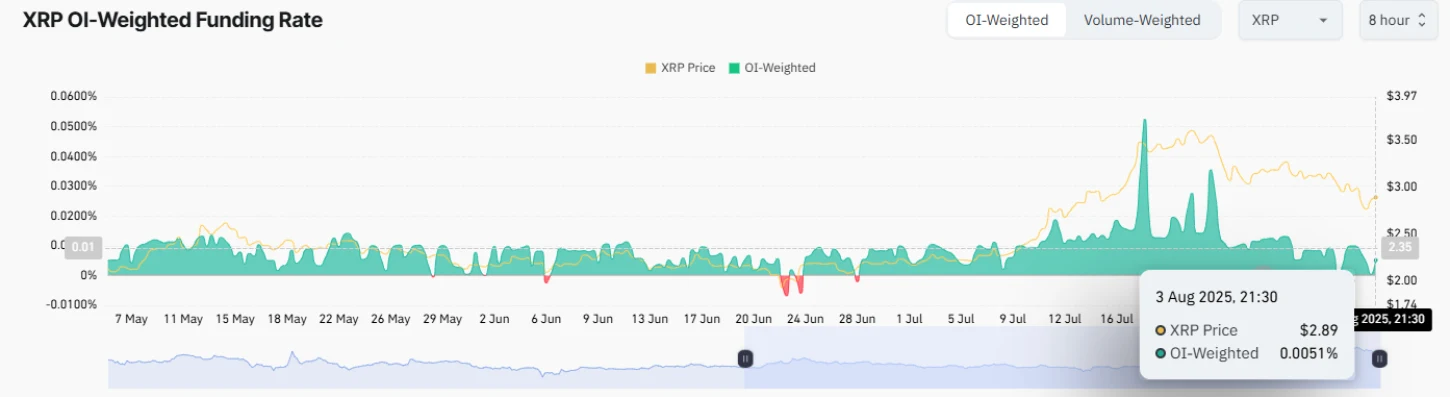
In addition, the XRP OI-weighted funding rate has started to shrink near neutral travel. Though the intraday gain has pushed the metric to 0.0051%, if the broader market correction persists, the XRP’s funding rate could turn negative.

XRP OI-Weighted Funding Rate | Coinglass

If materialized, this negative metric should indicate that short sellers are paying a premium to longs for holding their position, accentuating their confidence for a potential fall. As the majority of players are betting on further price decline, the current bearish momentum accelerates the prolonged downward drive.

Thus, until these metrics show a sharp upswing to signal the revival of prevailing market recovery, the Ripple crypto could decline further.

XRP Price Drives Current Correction Within Flag Pattern

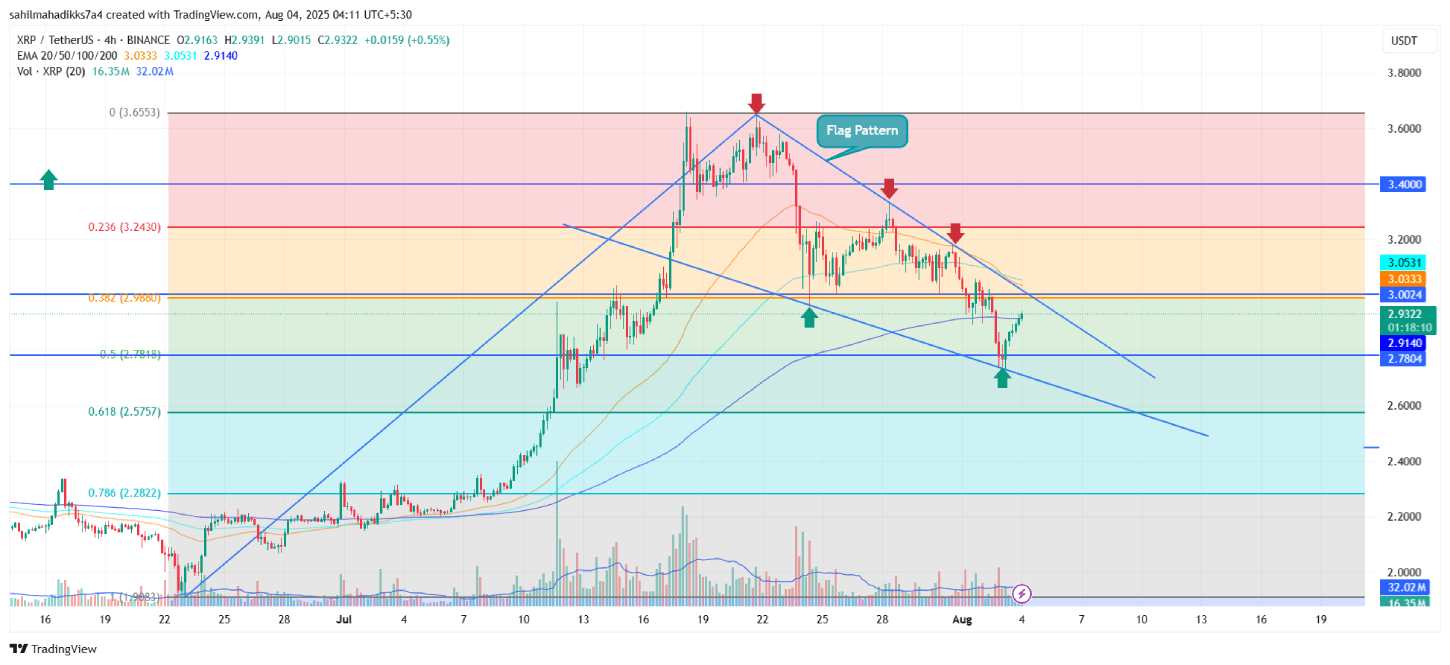
The four-hour chart analysis of the XRP price shows the recent correction resonated within two downsloping trendlines, revealing the formation of a bull flag pattern. The chart setup is characterized by a long ascending pole, which denotes the dominating trend in the market, followed by a temporary pullback to regain the bullish momentum. 

The chart setup is commonly spotted in the middle of an established uptrend to stabilize the price before the next leap. In addition, the pullback is backed by a declining trend in trading volume, further accentuating the weak conviction from sellers to sustain lower prices.

With an intraday gain of 5%, the XRP price tried to sustain above the 50% Fibonacci retracement level. Historically, the Fibonacci levels of 23.6%, 38.2%, and 50% have offered buyers strong pullback support. As the coin price holds above the daily exponential moving averages of 50, 100, and 200, the long-term trend is bullish.

Currently trading at $2.91, the XRP price is just 1% away from challenging the pattern’s resistance trend near the $3 psychological barrier. A potential breakout above this floor will signal the accelerating bullish momentum and drive a potential rally above the $3.65 high to hit $4.

XRP Price
XRP/USDT -1d Chart

However, with the declining trend in XRP’s future open interest, the anticipated breakout could be delayed and drive another bear cycle within the flag formation.

Also Read: Bitcoin Price Faces $110 Breakdown Amid U.S.-Russia Nuclear Tensions and Fresh Tariffs

Bitcoin Price Faces $110 Breakdown Amid U.S.-Russia Nuclear Tensions and Fresh Tariffs

Bitcoin Price Analysis

Key Highlights:

  • U.S. President Donald Trump has announced a fresh wave of reciprocal tariffs on several countries, which officially took effect at midnight on August 1.
  • Trump recently shared on the Truth Platform that he ordered two nuclear submarines to be positioned in the “appropriate regions” amid the escalating tension with Russia.
  • The Bitcoin price teases a bearish breakdown below the support trendline of the bull flag pattern, hinting at the mounting selling pressure in the market.
  • The BTC price positioned above the 50, 100, and 200 daily exponential moving averages indicates the broader bullish trend is intact.

The pioneer cryptocurrency Bitcoin dives 1.67% during Friday’s U.S. market hours to trade at $113,847. This selling pressure came around the escalating war of words between US President Donald Trump and the Deputy Chairman of the Russian Security Council, Dmitry Medvedev. The bearish momentum further accelerated as Trump announced new reciprocal tariffs on several countries, which went live on August 1st at midnight. The BTC price currently teases a bearish breakdown from the support trendline of the bull flag pattern, signaling a risk of prolonged downfall. 

Bitcoin Price Reacts to U.S.-Russia Nuclear Warnings

Since mid-July, the Bitcoin price has been wavering between the two horizontal levels of $120,000 and $117,000, which has accelerated the broader market uncertainty. However, the market selling pressures suddenly accelerated in the last 48 hours, and the Bitcoin price plunged from $117,833 to the current trading price of $113,967, accounting for 3.28%.

This bearish momentum can be attributed to escalating geopolitical tensions between the United States and Russia. On Thursday, former Russian President Dmitry Medvedev issued a stark warning to Donald Trump, urging him to consider “how dangerous the fabled ‘Dead Hand’ can be,” which refers to Russia’s Cold War-era nuclear deterrent system.

In a recent Truth post, Trump called Medvedev’s statement “highly provocative” and said, “I ordered two nuclear submarines to be positioned in the appropriate regions.” 

As tensions escalate between the two nations amid talks of nuclear weapons, the crypto market is beginning to feel the pressure.

The selling pressure further accelerated as Trump recently imposed a massive amount of new reciprocal tariffs on several countries. The new tariff took effect at midline on August 1, 2025.

Also Read: India’s Forex Reserves Climb to $698.19 Billion: RBI Report

BTC Price Teases Breakdown Below Bullish Flag Pattern

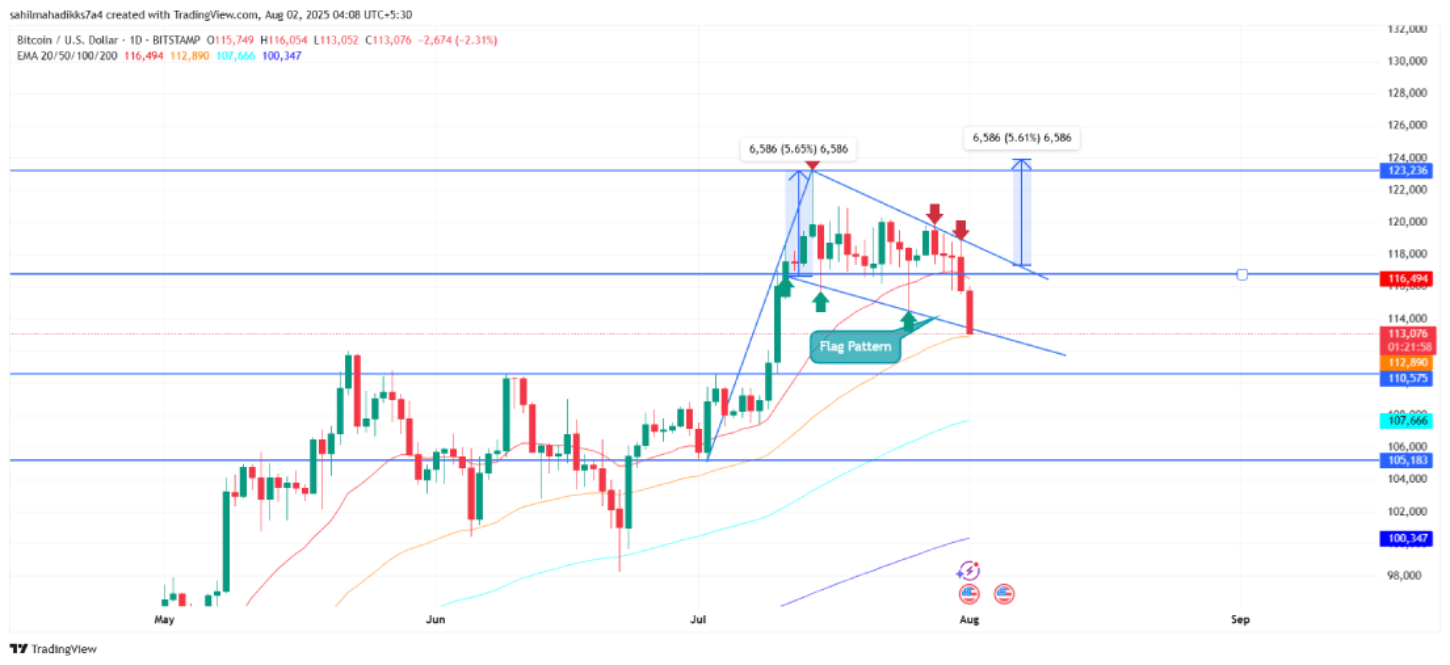
The daily chart analysis of Bitcoin price reveals that the recent market correction has resonated within two downward-sloping trendlines of a flag pattern. The chart setup is characterized by a long ascending trend called a pole, which highlights the dominating uptrend in price, followed by a temporary pullback to regain bullish momentum. 

Historically, the pattern has commonly emerged within an established uptrend to recoup the bullish momentum for a higher rally. 

With an intraday loss of 1.6%, the coin price teases a bearish breakdown from the pattern’s lower boundary at $113,270. A bearish breakdown from a renowned bullish pattern would signal the increasing seller’s strength and a risk of prolonged price correction.

If materialized, the BTC price could plunge to the next immediate support of $110,519, followed by a dive to the $105,200 level.

Bitcoin Price
BTC/USDT – 1d Chart

However, the BTC price is still positioned above the 50, 100, and 200 exponential moving averages, which indicates the broader market sentiment is bullish.

On the contrary, if the coin price manages to retain the flag structure, the current correction may prolong but gradually recoup the exhausted bullish momentum for the next leap.

Also Read: Mill City Injects $450M into SUI Treasury Strategy as Price Faces Bearish Breakdown

India’s Forex Reserves Climb to $698.19 Billion: RBI Report

India’s Forex Reserves Climb to $698.19 Billion: RBI Report

Key Highlights

  • Indian Forex Reserve soars by $2.7 billion in the week ending July 25
  • Foreign Currency Assets (FCAs) soared by $1.31 billion to $588.93 billion
  • RBI continues to intervene in currency markets to prevent excessive rupee fluctuations
  • According to experts, Trump’s 25% tariff could threaten Indian exports

India’s foreign exchange reserves surged by $2.7 billion in the week ending July 25, hitting a robust $698.19 billion, the Reserve Bank of India (RBI) reported on Friday. 

The spike amid ongoing heat from US President Donald Trump is showing the central bank’s rigorous efforts to fortify the economy against global uncertainties while maintaining stability in the rupee.

What’s the Story Behind This Growth

According to the report, the rise primarily comes from foreign currency assets (FCAs), which soared by $1.31 billion to $588.93 billion. 

FCAs, a key component of reserves, not only reflect just dollar holdings but also the fluctuating values of other major currencies like the euro, pound, and yen stashed away in the RBI’s coffers.

Gold reserves also played a major role, and jumped by $1.2 billion to $85.7 billion, which is a sign of the RBI’s strategic diversification. 

Meanwhile, Special Drawing Rights (SDRs), the IMF’s reserve currency, climbed up by $126 million to $18.8 billion, while India’s reserve position with the IMF improved by $55 million to $4.75 billion.

RBI’s Balancing Act in Forex Markets

The central bank has been actively intervening in forex markets to counter excessive volatility in the rupee’s exchange rate. 

However, RBI officials maintain that these moves are expected to ensure orderly market conditions rather than defending any particular rupee level. 

This measured approach has helped India in countering global currency turbulence while keeping its reserves healthy.

FDI and FPI Inflows Show Strong Investor Sentiment

The latest RBI monthly report has also disclosed another encouraging trend. According to the report, foreign direct investment (FDI) into India surged to $8.8 billion in April 2025, up from $5.9 billion in March and $7.2 billion in April 2024. 

Nearly half of these inflows were directed into manufacturing and business services, indicating growing confidence in India’s industrial and digital growth story.

India’s appeal as an investment hub has further increased its ranking as the world’s 16th-largest FDI destination. 

Between 2020 and 2024, the country attracted a staggering $114 billion in greenfield investments in the digital economy, the highest among all developing nations.

Foreign portfolio investors (FPIs) also showed renewed enthusiasm, pumping in a net $1.7 billion into Indian equities in May 2025. This marks the third consecutive month of inflows. 

Analysts attribute this optimism to a mix of domestic and global factors, including the India-Pakistan ceasefire, easing US-China trade tensions, and stronger-than-expected corporate earnings in Q4 of FY25.

What’s Next for India’s Forex Reserves?

With reserves inching closer to the $700 billion milestone, economists suggest that India is well-shielded against external shocks. 

However, the RBI remains watchful, balancing liquidity management with the need to keep the rupee stable. As global investors continue to bet on India’s growth trajectory, the country’s forex reserves are likely to remain a key barometer of its economic resilience.

Will Donald Trump’s tariffs cripple the Indian economy

Amid the positive growth in India’s foreign exchange reserves, a significant financial threat looms over India, which could hinder its economic growth. This week, US President Donald Trump announced a 25% tariff on Indian imports, effective August 7, citing India’s purchases of Russian oil and military equipment as support for Russia in the ongoing Russia-Ukraine conflict.

“The tariff (and penalty) now proposed by the US is higher than what we had anticipated and is therefore likely to pose a headwind to India’s GDP growth. The extent of the downside will depend on the size of the penalties imposed,” Aditi Nayar, chief economist at ratings agency Icra, said.

However, there is a hope that the Indian government and the US government will finalize a bilateral trade agreement by fall 2025.

“While this move is unfortunate and will have a clear bearing on our exports, we hope that this imposition of higher tariffs will be a short-term phenomenon and that a permanent trade deal between the two sides will be finalised soon,” Mr Harsha Vardhan Agarwal, president of industry body FICCI, stated.

Also Read: What is hedging in forex: Protect your investments and boost profits

Mill City Injects $450M into SUI Treasury Strategy as Price Faces Bearish Breakdown  

SUI

Key Highlight:

  • Mill City Ventures has closed a $450 million private investment in public equity (PIPE) to launch the SUI treasury strategy.
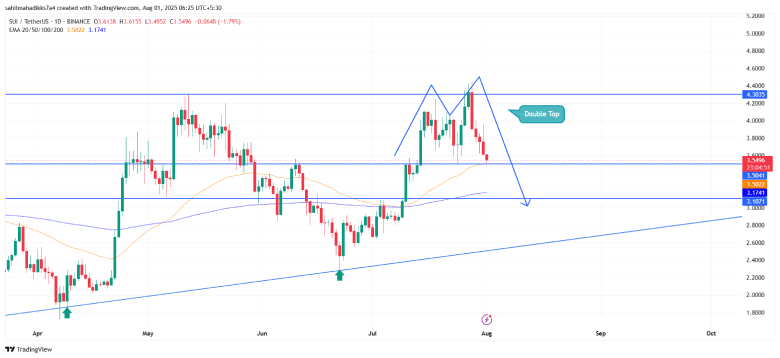
  • A double-top formation set the SUI price for a bearish breakdown below $3.5 to drive further correction.
  • The coin positioned above the daily exponential moving average 100 and 200 accentuates the broader lish trend.
  • A.G.P./Alliance Global Partners served as the exclusive placement agent for the offering.

On Thursday, July 31st, the crypto market witnessed a sharp sell-off, which extended the correction trend for the majority of major digital assets, including SUI. With an intraday sell-off of over 4%, the coin price is poised for a bearish breakdown below a key support level at $3.5. Despite the short-term bearish momentum, corporate adoption of SUI strengthens as Mill City Ventures announces a $450 million private investment in public equity to establish a Sui blockchain treasury strategy. Will the SUI price rebound?

Mill City Ventures Closes $450M Private Equity Deal

Mill City Ventures III, Ltd., a non-bank lender and specialty finance company, has announced a successful closing of a $450,000,000 private investment in public equity (PIPE) and an official commencement of an industry-first Sui blockchain treasury strategy.

Karatage Opportunities, a London-based proprietary hedge fund led by Marius Barnett and Stephen Mackintosh, spearheaded the investment along with a commitment from the SUI Foundation. The duo now takes the rein in Mill City, as Barnett joins as Chairman of the Board and as Chief investment 

“Our differentiated treasury strategy supporting this innovative blockchain is made possible through access to institutional-grade deal flow and an aligned vision with the Sui Foundation, said Stephen Mackintosh, newly appointed Chief Investment Officer of Mill City. Our Sui strategy is about more than passively holding tokens; it’s about actively partnering with the ecosystem to maximize long-term value creation.”

The investment lineup features some prominent names in Web3, including Galaxy Digital Inc., Dr. Jack Kong, Pantera Capital, ATW Partners, M2, Electric Capital, etc. 

Currently, the Mike City holds a total of 76,271,187 SUI in its treasury, which they acquired at an average price of $3.6389 per token through OTC. Market participants can now access the company’s treasury via a publicly traded wrapper with daily liquidity.

“Mill City is breaking new ground by offering public market investors a clean, liquid, and institutional-grade way to access the broader digital asset ecosystem. Anchoring its treasury to SUI and pairing that with seasoned leadership creates a powerful structure for long-term growth and exposure to one of the most promising blockchain platforms out there,” added Mike Novogratz, founder and CEO of Galaxy.

The company tends to utilize 95% of the PIPE proceeds to accumulate more SUI, showcasing their long-term perspective on this asset.

Also Read: Investing in the Philippine forex market: opportunities and challenges

Double Top Signals Sharp Correction for SUI Price

For the past week, the SUI price has witnessed a brief correction from $4.40 to the currently trading value of $3.58, registering a loss of nearly 20%. This downtrend in the daily chart shows a potential formation of a renowned reversal pattern called Double Bottom. 

The M-shaped structure indicates intense overhead resistance from above, which typically drives a sharp correction trend.

SUI
SUI/USDT -1d Chart

With today’s price dump, the coin price teases a bearish breakdown from the pattern neckline support at $3.58. A potential breakdown below this level will accelerate the bearish momentum and push the altcoin 11.3% down to hit $3.1 support.

Also Read: What is hedging in forex: Protect your investments and boost profits

What is hedging in forex: Protect your investments and boost profits

Forex hedging is a tactic used to minimize risks by trading financial instruments in opposite directions. It safeguards an expected or current position by holding open trades in opposite directions, for instance, simultaneously holding a short and a long trade. A wide range of market partners, including traders, organizations, and shareholders, usually uses Forex hedging. Using forex hedging properly, traders who go for long trading on a forex currency pair or remain in the prospect through trade can be protected from all kinds of uncertainties.

So, what is forex hedging? Hedging is when traders open a forex trade to offset another already opened. In other words, hedging helps restrict losses without using stop-loss strategies. In its most basic form, it protects traders from losing big in their market positions.

This article will discuss the principles of forex hedging, the different strategies used, and the underlying risks, costs, and fees.

Principles of Hedging in Forex

The first thing that every trader must bear in mind is that hedging is not a money-making strategy. It is only used to protect traders from making losses and not to earn a profit. Most hedges intend to eliminate a part of the exposure risk instead of the entirety of it. This is because there are certain costs involved in forex that often outweigh the benefits after a point. In addition to this, not all brokers allow hedging forex. Hence, traders must always check the terms on the official website before joining any forex trading platform.

Most forex traders who use hedging do it to protect themselves during unfavorable market conditions. Also, note that hedging is more common in the forex market than in other financial markets. This is because forex is considered more volatile than others.

What is Hedging in Forex Trading?

Let us take an example to understand what hedging is in forex trading. If a company (with the yen as the domestic currency) is willing to sell its products in USD, it can protect a part of its transaction by taking out the currency option that will gain if the yen increases in value against USD. If the transactions occur without any protection and somehow USD strengthens or remains stable against the yen, the company only loses the option costs. However, if USD weakens, profits made from the currency option can potentially offset some of the losses realized when the funds are received from the sale.

Who can Hedge in Forex?

The benefit of hedging forex allows traders to limit at least a part of exposure in the market they are trading in. If it is used at the right time and in the right way, it can put traders in a more profitable position. Now coming to the question, Who hedges forex? Loosely speaking, the answer is more subtle yet complex than one can think. As long as the forex brokers allow hedging on their platform, there is no one who can stop a trader from using it.

A majority of traders of all levels of experience can hedge in forex and use any of the strategies mentioned below. However, it is important to understand the principles of hedging, why and when it is used, and how the market will respond to it to benefit from forex hedging.

Forex Hedging Strategies

There is a wide range of forex hedging strategies that vary in terms of complexity. Some of the most commonly used forex hedging strategies that traders can use depend on their experience level. Here are the top three strategies used in forex hedging –

Simple Forex Hedging

Simple direct or forex hedging is a widely used and easy-to-understand strategy that traders can employ when they open a position to go long or buy any one forex currency pair. Traders can open the same position to go short or sell that particular currency pair. Direct hedging can be performed for various reasons. Although the net profit from this strategy is zero, traders can keep their original position ready when the market trend reverses. If the traders do not hedge the position, closing the trade would imply accepting the losses. However, if the traders decide to hedge, they can make money with the second trade as the market moves against the first.

Multiple Currency Hedging

Multiple currency hedging is a more complex strategy used while trading multiple currency pairs. This strategy can be effective to a certain level when traders buy a long position and then counteract a short position in one of the currencies. For instance, a trader may go long in the USD/GBP market and lacking in the JPY/USD market. In such a scenario, they are protected against their GBP exposure to a high degree. However, this strategy does not cover the movements in other currencies the traders are exposed to. If GBP or JPY fluctuate, they will still be exposed.

Forex Options Hedging

Currency options on forex give holders only the right and not the obligation to exchange currency pairs at given prices. Options on forex are popular tools for hedging as they offer traders the chance to minimize exposure while only paying for the cost of options.

For instance, if traders go long on AUD/USD, have opened a position at $0.76, and expect a sharp decline, they can go for hedging their risk with a put option at $0.75 with a month’s expiry. At the time of expiration, if the price of AUD/USD falls below $0.75, they will make a loss on their long position, but their option will be in the money and balance their exposure. However, if the currency pair rises, they can let their options expire and pay only the premium.

Risks of Forex Hedging Strategies

Forex hedging strategies operate similarly to stop loss orders as they both limit losses. However, forex hedging allows traders to make money on hedged trades if performed correctly. Traders often make a big mistake by considering forex trading strategies as a way to place equal and opposite trades to the one they have already opened. However, that is not how forex hedging works.

The three main hedging methods in currency trading are futures, spot agreements, and forex currency options. The typical trades created by traders are called spot agreements. Spot agreements are not the most effective method of currency hedging because of their short-term delivery period.

A successful strategy requires holding short and long trades simultaneously on the same currency pair. Hedging is generally used to stop profits or losses during reversals. If the market goes up and the traders are short, they might purchase to temporarily hold a position until the market reverses back in their favor. Many traders have the wrong idea, believing that no risks are involved since they are completely hedged. It is incorrect to let the trade run for weeks or months. Forex heading strategies can lead to massive losses if traders do not consider other major factors, such as carrying costs.

Overall, every trader must learn how to use forex hedging strategies and went to employ them since they are most likely to end up making 2 losing trade positions instead of just one. To ensure whether there is an opportunity for forex hedging, traders must rely on different tools for technical analysis. No trader will like to make losses or unsuccessful trades while trading in foreign currencies, and hence, they must always proceed with greater caution and use forex hedging strategies wisely.

Hedging Cost & Fees

Hedging forex does not have direct fees, but based on the chosen forex broker, traders may have to pay commissions or spreads on the financial markets they are trading in. In addition, other fees may be associated with forex hedging, such as the swap fee for traders who keep their positions open overnight.

It must be noted that the goal of forex hedging is not to make money but to protect trades against losses. Therefore, the cost of hedging cannot be avoided, whether it is the cost of options or lost profits from being on an unfortunate side of foreign exchange. If the cost of forex hedging becomes too high, traders can de-hedge or close out of a current hedge position if it is no longer required.

Cyber threats and forex trading in Indonesia: what you need to know?

Cyber threats and forex trading in Indonesia: what you need to know?

Cyber security risks have increased more than ever with the exponentially rising popularity of forex trading worldwide. There has been an increase in the opportunity for cybercriminals like hackers and scammers, which has led to multiple malicious attacks in the financial industry. This has resulted in more stringent financial regulations on a global level, requiring brokers and traders to be vigilant while offering and using trading services, respectively. Both traders and brokers can, directly and indirectly, be a victim of cybercrimes. 

Cybercriminals can target forex traders by accessing their trading accounts using their passwords and transferring funds or simply targeting the forex broker. Brokerage platforms have client records concerning their personal and financial information, which presents significant concerns. There is practically no broker that can fully guarantee Indonesian traders that they will never fall victim to cyber-attacks. However, several measures have been taken to add protection while trading foreign currencies in Indonesia.

Phonics on foreign exchange is the world’s largest and most attractive financial market, open 24 hours a day, five days a week, with more than $6 trillion traded daily. Forex trading involves exchanging foreign currencies driven by the goal of the profit motive of Indonesian traders. 

This article will deal with various forms of cyber threats in forex trading and give valuable insights into Indonesia’s different cyber security measures and regulations. This article will also discuss the advantages and risks of forex trading.

Cyber Threats in Forex Trading

Cyber threats to forex trading in Indonesia can be of different types that traders must be aware of – 

  • Malware – Malware is malicious software or code inserted into a system that compromises data integrity, availability, or confidentiality. It can secretly affect data, operating systems, or applications used while trading foreign currencies. 
  • Ransomware – Ransomware limits or prevents users from accessing their systems through malware. This type of cyber threat asks the users to pay a ransom using their choice of payment methods to gain access to their data or system. Online payment methods offered by forex brokers in Indonesia usually include fiat and virtual currencies that can be stolen using ransomware. 
  • DDoS – Distributed Denial of Service (DDoS) attacks make online services provided by forex brokers unavailable by introducing excessive traffic from various sources and locations to the platform. 
  • Phishing and Spamming – Phishing is a type of social engineering that includes attempts to obtain sensitive information. This is a common form of cyber threat, the attempts of which appear to be from a reliable and trustworthy business or person. Spamming involves unsolicited, undesirable, and unwanted emails or messages that ask the users to do something, usually including asking for sensitive information.

Cybersecurity Measures for Forex Trading

Financial service providers such as forex brokers have become the most attractive targets for hackers. Around 45% of all providers admit to facing different forms of cybercrimes or cyber attacks during their operations. The best forex broker in Indonesia has developed several security precautions and measures, such as the 256-bit SSL (secure sockets layer) encryption protocol. Several forex brokers hold client funds in segregated bank accounts to provide an additional layer of security and ensure that the funds are not used for business purposes. 

Furthermore, forex brokers in Indonesia also ensure that all personal and financial information their clients provides is decentralized. This means that no central authorities like the government, banks, and other financial institutions can gain access to sensitive information. With this, there is no mean system to target. Even if hackers can find any vulnerable point in the design, nothing can be done with the information they receive.

The best forex brokers in Indonesia can avoid cyber threats, fishing attacks, hacking, and data breaches by using robust security measures to protect forex trading accounts, such as regular system and software updates, encryption technologies, and multi-factor authentication. They must also educate employees and traders on the best data security practices and monitor their software systems regularly for unauthorized access or potential breaches.

Cybersecurity Regulations in Indonesia

Electronic Information and Transactions Law (EIT Law) performs cyber security regulation in Indonesia. It covers many offenses like distributing illegal content, data, breaches, unauthorized and unlawful access, and interception of electronic systems. It protects Indonesian traders illegally and contains strong provisions to protect personal data and website authentication to avoid fraudulent, fake, and scam websites. 

It also emphasizes the urgent need for the government authorities to prevent cyber theft and misuse of electronic information and transactions on forex trading platforms, along with the need to create a national cyber security measure or strategy. To deal with cyber security problems on a national level, the Ministry of Defence Regulation provides guidelines for cyber defense. Overall, there have been many attempts to pass cyber security bills in the country to keep up with technological advancements and rising threats. 

Forex traders found it convenient to provide financial services to Indonesian traders. They were relatively safe from any intrusion of government bodies due to the absence of regulatory guidelines monitoring the operations of forex brokers. However, the government started to initiate a movement concentrating on eradicating the increasing number of malpractices and forex scams, resulting in massive losses for traders. The best forex broker in Indonesia is now required to provide detailed information about any broker complaints and scams lodged against the companies through the TRUST+ website to allow traders to become more aware of such fraudulent practices prevalent in the forex industry. Forex brokers now have to match the quality and sophistication of services generally provided by global brokers to comply with the relevant regulatory authorities’ terms and conditions.

Advantages of Secure Forex Trading in Indonesia

Here are the top advantages of secure forex trading in Indonesia – 

  • World’s largest financial market – Since forex is the largest market in the world, there is no way it will cede this title anytime soon. Around $5 trillion to $6 trillion on average is traded daily. 
  • High liquidity and volume – Forex trading involves deep liquidity. Given the massive volumes of trades made per second, traders do not have to wait to get their money back under normal market conditions. With a simple buy or sell click, they can place a trade or get back their money whenever they want. 
  • 24-hour market – Forex trading can be done 24 hours a day, five days a week, without waiting for the opening or closing bell. Traders can be as active/passive as they want and trade on their schedule. 
  • Low transaction costs – The difference between the bid and asking prices is the spread, which is the transaction cost traders pay. Indonesia’s best forex broker offers competitive spaces that minimize trading costs and maximize profits. 
  • Leverage – With leverage, traders can easily borrow from brokers to place their trades above their deposited funds. This powerful tool gives increased purchasing power and more significant gains. However, note that it also carries a loss risk, as explained in the section below.

Risks of Insecure Forex Trading in Indonesia

There are many risks of insecure forex trading in Indonesia, including – 

  • Leverage risk – Forex trading leverage involves a small initial deposit called the margin necessary for placing forex trades due to price volatility that may be fluctuations in the currency prices, leading to margin calls, where Indonesian traders have to pay more than their deposits as margin. Using leverage aggressively during a volatile market may lead to substantial losses. 
  • Difficult to determine market price – The exchange rate of any currency pair is influenced by an array of elements like central banks, global politics, and other economic factors that can be difficult to conclude and obtain a meaningful result. Since forex trading is based on fundamental and technical analysis, incorrectly interpreting such information or misreading a chart can lead to negative trades. 
  • Highly volatile – The forex market is extremely volatile, which can be used to make money but can also lead to losses without any control over macroeconomic and geopolitical developments. This volatile nature of currency pairs makes it difficult for traders to monitor the market 24×5 and, therefore, suffer from losses.

Conclusion

Cyber security is an essential part of the forex industry in the world we are living in today. Choosing a regulated forex broker with a reliable trading platform that uses top-notch security measures can help traders make secure forex trades and reduce the likelihood of witnessing a cybercrime. Best practices for staying safe while forex trading includes deploying firewalls and malware with advanced protection capabilities against data breaches and malicious exploits. 

In addition, Indonesian traders must always take necessary precautions to secure their trading accounts and information, such as using a strong and unique password or setting up two- or multi-factor authentication.

Investing in the Philippine forex market: opportunities and challenges

Investing in the Philippine forex market: opportunities and challenges

The Philippine forex market established itself as a profitable avenue for traders and investors, especially with the regulatory policy setup, favorable market outlook, and a conducive environment. A forex trading career can be lucrative but has a steep learning curve since trading foreign currencies involves high risk, volatility, and leverage. Continuous learning, effective capital management techniques, and perseverance are required to be successful in the Philippine forex market. 

Even with many challenges ahead, forex trading should be considered a profitable opportunity instead of viewing it as a challenge since the forex industry is one of the largest and most liquid in the world and is here to stay for the longest time. It may appear to be a simple money-making career, but trading in foreign currencies is quite complex. Traders must be able to take risks associated with forex trading and build a proper trading plan to meet all kinds of uncertainties in the market. 

This article will focus on the challenges, opportunities, and strategies surrounding the Philippine forex trading market to help novice traders make profitable decisions. 

Opportunities in the Philippine Forex Market 

Size and Liquidity of the Market

The global foreign exchange market has a turnover of over $7.5 trillion daily, about 30 times more than the global GDP. The Philippine forex market is an OTC (over-the-counter) market as it runs entirely electronically within the network of non-bank financial institutions (NBFIs) and banks, continuously for 24 hours, five days a week. The market is spread all around the world without any central location, and it is by far the world’s largest and most popular financial market. 

The US Dollar makes up 84.9% of all the transactions in the world, making USD the most traded currency, followed by the euro and yen, which stand at 39.1% and 19%, respectively. The forex market did not exist a century ago, and hence, it is often considered a truly new financial market, unlike the stock and commodities markets. The recent rapid economic growth in the Philippines has led to an expansion in the forex market. 

However, it is too small relative to its Asian peers. As a matter of fact, the Philippines Stock Exchange had the lowest number of Asia’s listed companies in 2019, standing at only 267. The combined market cap of the Philippines listed companies totaled $324.4 billion, equivalent to 84% of the GDP of the Philippines. The Philippines’ forex market is highly liquid since the currencies trade 24 hours during weekdays. Prime forex brokers are the major liquidity sources in the forex market that act as middlemen between retail traders and financial institutions.

Comparison of the Philippine Forex Market to Other Markets

Unlike stocks, commodities, and options, forex trading does not require a lot of money which appeals to many traders around the world. Additionally, the enormous market is highly liquid, given the huge volumes being traded every second, the size of the forex market, and the number of participants. There is no single institution or government that controls the market and currency prices, allowing it to quickly calibrate and level itself based on market demand and supply. Moreover, since it is decentralized, no middleman facilitates the trade, giving complete freedom to the traders in the Philippines.

Analysis of Potential Investment Opportunities in the Market

Forex trading in the Philippines is gaining popularity as forex brokers come under the Philippines Securities and Exchange Commission, the sole regulatory body overseeing the domestic forex market. The best forex broker Philippines, operating internationally, does not require a license under the SEC to accept traders. However, regulations may apply if any offshore forex broker attends to reign in scams and fraud. Forex trading is legal in the country only if the brokers are authorized by the SEC. 

There are no such laws prohibiting traders from participating in the forex market in the Philippines. Seeing the potential opportunities in the Philippines forex market, it is becoming increasingly popular among traders with the added benefits over other forms of trading. Forex trading is the largest financial market in the world and is truly the most global and accessible for every trader, irrespective of the level of experience. 

Benefits of Investing in the Philippine Forex Market

One of the benefits of forex trading in the Philippines is that it allows traders to dip their toes into foreign markets. By investing in different currencies, traders can diversify their portfolios and minimize risks by using different currencies to hedge against economic downturns. Another great advantage of trading in foreign currencies is high leverage, with which traders can make huge profits by winning trades. However, it can also work the other way around and bring great losses.

Challenges in the Philippine Forex Market

Risks Associated with the Market

Like any other form of trading, forex also comes with its own share of risks and uncertainties. Traders must acknowledge the risks associated with the market before investing money. Most of the forex trading products are highly leveraged. The trades require a small initial amount, called the margin, to start trading in foreign currencies. Even the smallest fluctuations in currency prices can result in margin calls that require traders to pay additional margins. 

Traders must be aware of the fact that using leverage aggressively can increase their losses during unfavorable market conditions. Secondly, the exchange rates tend to be extremely volatile due to market demand and supply fluctuations. As long as the traders’ positions are outstanding, they are subject to price changes. This exchange rate risk can be substantial based on the movements of currency prices. Moreover, since forex is unregulated, there are no price limits imposed, unlike regulated financial markets. 

Another major risk comes in the form of liquidity, which increases the possibility of making losses arising from specific situations where the market and the assets become illiquid, meaning that trades can not be placed as quickly enough as possible. Forex trading is substantially more prone to periods of illiquidity that may prevent traders from executing their favorable and profitable trades. Also, factors like forex scams are also a matter of concern for traders, so they have to choose carefully.

Impact of Economic and Political Factors on the Market

There are many factors that can potentially affect the forex market forces, including economic, political, and also psychological factors. Economic factors play a huge role in regulating the forex market, which includes trade balances, inflation, the government’s economic policies, and the outlook on economic growth and development. Political conditions may also exert a substantial impact on the exchange rate, such as political conflicts and instability that may adversely affect the currency’s strength. The psychology of forex traders also has a great influence on the exchange rate since forex trades are mostly driven by human emotions like fear and greed.

The Regulatory Environment and Its Challenges

Coming to the main challenge faced by forex brokers in the Philippines is the regulatory environment persisting in the economy. Banko Sentral ng Pilipinas (BSP) is the monitoring institution that looks after the economy’s performance for a stable and safe trading and business environment. Forex brokers in the Philippines are regulated by the SEC (Securities and Exchange Commission) and are required to abide by the policies implemented by the government authorities.

Challenges Faced by Forex Brokers in the Philippines

All financial organizations, including forex brokers, need to be licensed directly or indirectly by the government of the Philippines under the SEC, and the BSP-regulated brokers have to follow the regulations and guidelines imposed by the regulatory body. SEC issues license to forex brokers and exercise the power to cancel, suspend, renew, or terminate trading licenses based on the conduct of the brokerage firms. SEC is the ultimate regulatory authority determining whether a company is qualified enough to obtain a valid license to provide forex services to Philippines traders.

Strategies for Investing in the Philippine Forex Market

The Philippine forex market has five trading strategies that can be effective for traders while executing trades. 

  • Scalping – Trading short-term and at high volumes that involve entering and exiting the forex market quickly to grab a few pips. The process of scalping can be repeated several times a day according to the preference of the traders. 
  • Day trading – This strategy can be used to avoid risks associated with taking overnight positions. Day trading involves entering and exiting transactions during a single trade session. Day trading decisions are based more on technical analysis by looking at historical trends and patterns. 
  • News trading – By taking advantage of the market volatility that takes place soon after important news is released is called news trading. Current economic events drive the currency prices or exchange rates. Hence, traders must always be on the toes minute-to-minute while trading foreign currencies. 
  • Swing trading – This trading strategy is used to enter or exit the market based on technical indicators, aiming at buying low and selling high. 
  • Trend trading – This strategy involves long-term trades by looking at established current directional movements or trends and trading along until they conclude. These are future or long-term trades. 

Importance of Risk Management in Forex Trading

Regardless of the trading strategies used while trading foreign currencies, it is important to implement risk management strategies by setting rules and measures to ensure all negative impacts of forex trading are manageable. It is an essential part of forex trading for inexperienced traders and professionals. The main objective of risk management is to avoid all possible losses from unpredictable exchange rates and market conditions. 

The currency market faces rapid fluctuations driven by various fundamental factors like fiscal and monetary policies, market psychology, geopolitical instability, speculation, technical factors, and significant economic events. Traders must be able to manage risks in forex trading by understanding the forex market properly, getting a good grasp on the concept of leverage and risk-reward ratio, and managing human emotions at best.

Role of Technology in Forex Trading in the Philippines

Technology has allowed traders to track their day-to-day trades and expenses, ensuring success at forex trading that was otherwise considered a tedious activity performed manually. With the right tools, trading in foreign currencies can be done in the comfort of your home. Having a powerful and reliable internet connection, the right hardware, and the best trading software and platforms can provide significant comfort and ease to traders in the Philippines.

Conclusion 

With the more stringent regulation and simultaneous rising popularity of the Philippines forex market, there are various opportunities and challenges that traders face. The Securities and Exchange Commission in the Philippines imposed an unfavorable regulatory environment that has made traders think twice about trading foreign currencies in the country. 

Traders should note the additional risks of creating a trading account with international forex brokers to trade forex in the country. Although it is a promising sector that yields good returns in the long run, traders must measure the risks and benefits before investing money. With the right blend of trading strategies, traders can go a long way and make a career out of forex trading.

How can you make money with forex in Nigeria?

How can you make money with forex in Nigeria?

Forex trading involves buying and selling currencies on the alternate overseas market. To exchange forex, you must get in touch with a broker that approves you to purchase and promote foreign money pairs. Nigeria has been very active in the foreign exchange buying and selling market for many years now. However, it is only recently that retail buying and selling became accessible to all kinds of investors. Before this, only institutional buyers such as banks and massive companies were capable of exchanging forex. Nigeria provides a very conducive environment for forex trading. So let’s see how you can make the best of the opportunities!

Understanding the Basics of Forex Trading

Forex buying and selling is the system of shopping for and promoting overseas currencies to make a profit. It is one of the most famous forms of investing, and it affords a variety of benefits, including the capacity to make cash in each rising and falling market. When you exchange forex, you correctly speculate on the movement of forex pairs. For example, if you accept as true that the US greenback will move upward towards the euro, you would purchase USD/EUR. If your prediction comes true, you will make a profit. If not, you will incur a loss. 

When it comes to forex trading, many people do not understand how it works. Forex trading involves trading currencies against each other to make a profit. Currencies are usually traded in pairs, so you may be shopping for one forex while concurrently promoting another. The intention is to purchase low and promote high, and your earnings will come from the price difference.

There are unique foreign exchange markets, each with its own aspects and benefits. The four major types of foreign exchange markets are the spot market, the forwards market, the futures market, and the selections market.

The spot market is the most famous foreign exchange market, providing on-the-spot shipping of currencies at modern prices. Spot transactions are normally between two banks or a financial institution and a customer. The forwards market is comparable to the spot market; however, it includes contracts for the future transport of currencies at agreed-upon prices.

You ought to comprehend a few primary foreign exchange buying and selling terminologies before venturing into the world of forex trading.

Some of the most necessary terms are explained below:

  • Pip: its smallest unit of dimension in foreign exchange trading. It is generally equal to 0.0001 of a foreign money pair.
  • Lot: A lot is a preferred unit of measure in foreign exchange trading. It is generally equal to 100,000 of a foreign money pair.
  • Leverage: Leverage is the use of borrowed capital to extend your plausible returns on investment.
  • Margin: Margin is the quantity of cash that you need to have in your account to open and keep a position.

Setting Up a Forex Trading Account in Nigeria

Choosing a reliable foreign exchange broking is an essential selection that can notably affect your buying and selling success which also offers different trading accounts. Here are guidelines to help you choose the best option from the list of registered forex brokers in Nigeria:

  • Regulation: Look for a dealer regulated through a respectable monetary authority.
  • Reputation: Check online evaluations and scores from different merchants to see how the brokering company is perceived in the industry.
  • Trading platform: Make certain the dealer provides a buying and selling platform that fits your wishes and is user-friendly.
  • Customer support: Ensure that the broker presents excellent client support, along with 24/7 availability, stay chat, email, and cell phone support.

Are you wondering about the Requirements for opening a forex trading account? Read on to find out more! 

  • Choose an authentic foreign exchange broker: Study and evaluate exclusive foreign exchange brokers to discover one that fits your buying and selling wants and preferences.
  • Complete the utility process: Once you’ve chosen a broker, you may want to complete the account utility process.
  • Verify your identity: To comply with anti-money laundering regulations, most brokers will require you to furnish extra documentation to confirm your identity.

Types of Forex Trading Accounts

Numerous foreign exchange buying and selling bills are reachable to traders via trading accounts. Here are some of the most frequent ones:

  • Standard Account: This is the most frequent forex buying and selling account. It requires a minimum credit of $100 to $500.
  • Mini Account: A mini foreign exchange account is best for novices who desire to begin buying and selling with a small quantity of money.

How to fund a forex trading account in Nigeria:- There are quite a few methods to fund a foreign exchange buying and selling account in Nigeria:

  • Bank Transfer: This is the most frequent and best way to fund a foreign exchange buying and selling account.
  • Debit/Credit Card: Many foreign exchange brokers in Nigeria accept debit and credit score card payments. You can fund your buying and selling account using your Visa or MasterCard.
  • Bitcoin: Some foreign exchange brokers in Nigeria accept Bitcoin payments. You can purchase Bitcoin from a cryptocurrency change in Nigeria and then switch the Bitcoin to your foreign exchange broker’s pocket address.

Tips for Successful Forex Trading in Nigeria

  • Keeping up-to-date with market news and events: Follow information outlets: Nigerian traders can observe neighborhood and worldwide information stores to remain knowledgeable about market information and events.
  • Use social media: Social media platforms such as Twitter, LinkedIn, and Facebook can be beneficial for enterprise leaders and experts to stay updated with market tendencies and news.
  • Utilize market evaluation tools: Nigerian merchants can use market evaluation equipment such as buying and selling platforms, information aggregators, and monetary calendars to get the right of entry to real-time data, news, and analysis.
  • Staying disciplined and patient: Staying disciplined and unaffected are vital for merchants in any market. Here are some guidelines for Nigerian traders to remain disciplined and patient:
  • Stick to a buying and selling plan: Nigerian merchants ought to have a buying and selling layout that outlines their goals, strategies, change management, and necessary factors.
  • Manage risk: Nigerian merchants must manipulate their chance by using suited function sizing, diversifying their portfolio, and fending off overleveraging.
  • Be patient: Nigerian merchants must be detached and not rush into the trade. It’s vital to wait for the proper possibilities and jump into trades.

Here are some advantages of retaining a buying and selling journal:

  • Keeps you accountable: When you write down your trades, you are maintaining you are keeping a record of your decisions, good and bad.
  • Helps you manipulate risk: By monitoring your function measurement and stop-loss levels, you can ensure you are appropriately managing threats.
  • Learning from mistakes: Learning from errors for Nigerian traders would involve the following:
  • Understanding market trends:- Traders need to be conscious of market developments and make selections based on data, not emotions.
  • Risk management: Traders have to avoid over-leveraging and invest solely in what they can find the money to lose.
  • Diversification: Traders need to mitigate threats through one-of-a-kind assets rather than placing all their cash in one investment.
  • Learning from previous mistakes: Traders must assess their previous trades, become aware of what went wrong, and avoid repeating equal errors in the future.

Risks of Forex Trading

Market volatility:- One of the fundamental dangers of forex buying and selling is market volatility. The overseas change market is the riskiest economic market, and the price of currencies can fluctuate unexpectedly and unpredictably. Market volatility can be caused by a range of factors such as political events, financial reports, and different surprising events.

The surprising and massive actions in forex costs can cause extensive losses to forex merchants who are not adequately prepared.

Leverage:- Leverage is an approach used by foreign exchange merchants to increase their profits.

Leverage approves merchants to manage more cash in the market than they simply have in their buying and selling accounts. 

Fraudulent brokers:- 

Traders must be aware of fraudulent brokers that result in forex scams, they usually operate in the following ways:

Offering unrealistic returns: Fraudulent brokers frequently entice merchants with guarantees of excessive returns that are too good to be true. 

Pressure tactics: Fraudulent brokers may also use high-pressure sales systems to pressure merchants to invest extra cash or make rapid selections without much research.

Lack of regulation: Lack of legislation refers to a scenario with no guidelines or pointers governing a precise pastime or sector. It can end in terrible outcomes, such as unfair competition, heavy fines, or security standards. Traders must look for brokers licensed by regulating bodies.

Conclusion

Our article presents an overview of foreign exchange trading in Nigeria. Forex trading of currencies affords a variety of benefits. We have given you an overview of everything from basic terminologies and markets of trading, setting up a trading account in Nigeria, to tried and tested tips for successful trading, and ways to mitigate risks. 

We must reiterate that education and self-discipline are two crucial elements of profitable forex trading. Education is fundamental because the foreign exchange market is complicated and dynamic, and it requires a deep appreciation of the crucial and technical elements that inform currency movements. Keeping a calm mind is equally important. Happy trading!