

Foreign exchange trading remained quiet on Tuesday, with large institutional investors reducing risk. The dollar index was around 99.84. The euro held close to 1.1545 dollars, while the Australian dollar remained confined to around 0.7055 dollars. The absence of a clear trend is a reflection of the concurrent evaluation of weaker employment data from the United States, ongoing energy-supply uncertainty, and the upcoming release of the inflation data, which will shape policy sentiment.
Employment Data and Shifting Rate Assumptions
Nonfarm payrolls in July dropped by 23,000. Private-sector jobs grew by approximately 30,000, while government jobs fell by 53,000, including a drop of nearly 50,000 local education jobs. The unemployment rate edged lower to 4.1%, and the labor-force participation rate slipped to 61.4%. These results stood in contrast to previous market positioning that had anticipated a possible rate hike by the Fed later in the year, helping to drag down sovereign yields across several markets.
Delayed Deal Between U.S. and Iran Pushed Oil Price Up
Negotiations to reopen the Strait of Hormuz have stalled as U.S. President Donald Trump demands extensive historical reparations from Iran following Tehran’s own compensation demands. This diplomatic impasse has resulted in surging oil prices and increased global economic anxiety. As a result, the Crude oil price rose to a multi-week high, with the global benchmark index Brent Crude surging to $88.23 per barrel and West Texas Intermediate (WTI) to $82.47 per barrel.
The volume of shipping traffic through the waterway was considerably below recent levels, and both sides added extra conditions to delay any agreement. The U.S. is a net energy producer and thus is not as directly impacted by higher oil prices as net importers would be. The structural disparity has kept the dollar from falling a lot despite the weaker labor data.
European Growth and Price Dynamics
The euro remained trapped in a tight interval as the European Central Bank (ECB) navigated rising energy prices and divergent demand across Europe. Preliminary data for the euro area’s gross domestic product (GDP) indicated that the economy expanded by a modest 0.1% in the first quarter of this year, though upward revisions across the region have slightly brightened the baseline outlook. Notably, Spain demonstrated more robust growth (+0.6%) than both Germany and France.
Meanwhile, the euro-area annual inflation rate increased further to 2.9% in July, propelled primarily by mounting energy costs. Key national data expected later this week from Germany, France, and Spain will help confirm whether domestic demand can withstand these heightened cost pressures. Ultimately, the combination of surging energy liabilities and soft economic growth is expected to restrict the ECB’s policy options and cap sustained euro gains.
Focus on the July Consumer Price Index
Focus is now on the United States Consumer Price Index (CPI), due Wednesday. The core price index is expected to increase by 0.2% month-on-month. If the reading falls below that threshold, it would indicate that the cooling labor market is successfully dampening price pressures, likely cementing further Federal Reserve inaction. Under this soft-inflation scenario, the dollar index could slide below 99.00, driving the euro above 1.1600.
Conversely, a hotter-than-expected print would signal a prolonged period of elevated U.S. interest rates, triggering a wave of short-dollar trade covering.
EURO Gains Strength Against Dollar Amid a Chart Major Breakout
Over the past two weeks, the EUR/USD pair has rallied from 1.1353 to the current exchange value of 1.154, registering a 1.66% spike. In the technical chart, this recovery in euro value against the dollar signalled a major breakout from a key resistance trendline in the daily chart.
Since late January 2026, a downswing trendline has limited euro recovery as a constant overhead supply. Therefore, the recent breakout signals a positive sentiment shift among currency speculators for EURO.
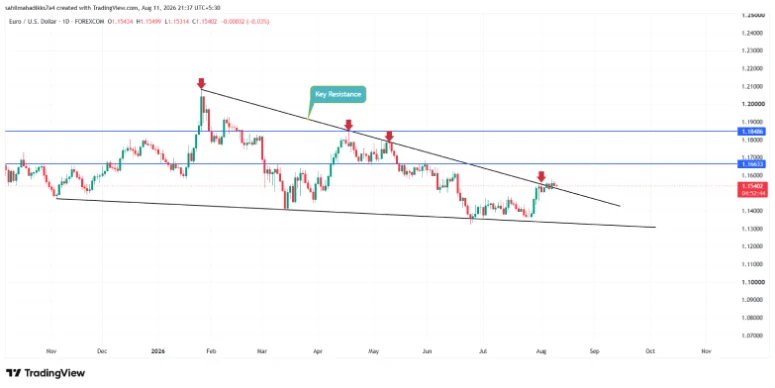
If the current consolidation in the EUR/USD pair holds the breakout line, the EURO could continue its rally to 1.166 or 1.184.